

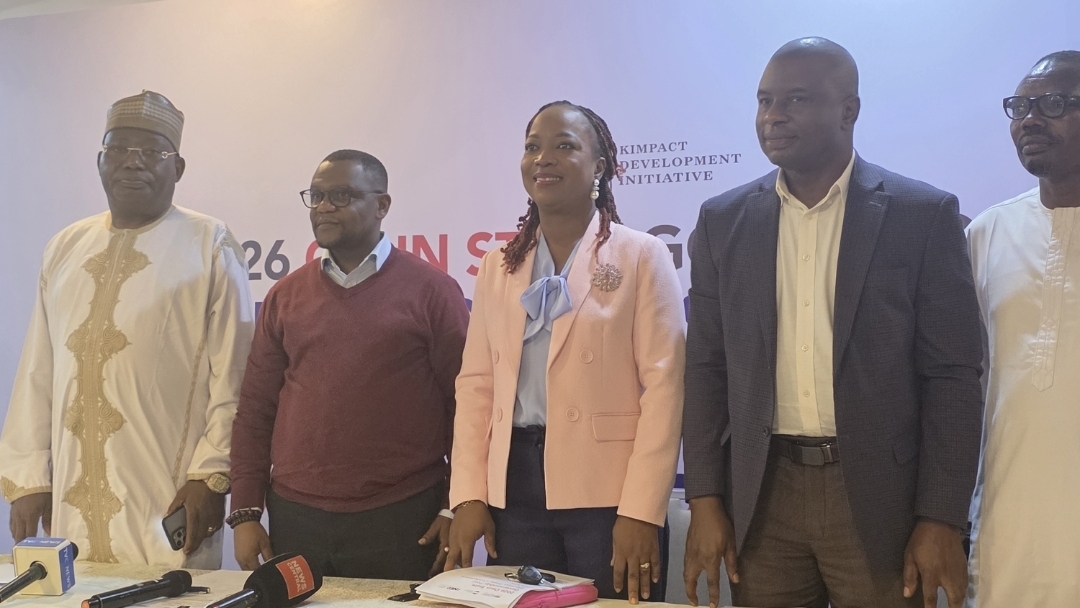
The Kimpact Development Initiative has raised concerns over the conduct of the 2026 Osun State governorship election, citing challenges with the Bimodal Voter Accreditation System, voter inducement and discrepancies in some polling-unit results.
The organisation disclosed this at its 2026 Osun State Governorship Post-Election Press Conference in Abuja on Thursday.
A KDI faculty member, Prof. Ernest Ereke, said the election was largely peaceful and conducted successfully across most polling units.
He, however, said weaknesses observed during the exercise required urgent attention ahead of the 2027 general elections.
Ereke said KDI deployed 370 accredited observers across the 30 local government areas, 332 wards and 1,660 polling units in the state.
According to him, accreditation and voting commenced before KDI’s 8:45am operational benchmark in 74.5 per cent of the polling units monitored.
He said 25.5 per cent of the locations recorded delays.
“98 per cent of polling units observed received election materials in good condition,” Ereke said.
On BVAS, he said the technology successfully processed accreditation in 84.9 per cent of observed cases.
This, he said, represented a 15.1 per cent observed failure rate.
Ereke said the figure was an improvement on the 82.6 per cent BVAS functionality recorded during the 2026 Ekiti governorship election.
He, however, noted that it was below the 96 per cent recorded during the 2025 Anambra governorship election.
“Our observers also reported widespread difficulties with fingerprint recognition, forcing the use of facial recognition in many locations,” he said.
“Elderly voters were particularly affected, with some experiencing difficulties with both fingerprint and facial recognition.”
He urged the Independent National Electoral Commission to assess BVAS performance across different categories of voters and authentication methods before the 2027 elections.
KDI also reported cases of voter inducement across the state’s 30 local government areas.
The organisation said party supporters accounted for 46.8 per cent of reported actors involved in inducement, while party agents accounted for 29.8 per cent.
Voters accounted for 10.6 per cent, while community leaders represented 9.6 per cent of reported actors.
KDI said the reported inducements included food, drinks and cash payments ranging from N5,000 to N50,000.
It added that some of the reported transactions occurred away from polling units, including inside vehicles, food vendors’ outlets and provision shops.
The organisation consequently called for broader monitoring strategies to address changing methods of voter inducement.
1
Speaking on election-related violence, a KDI faculty member and retired Assistant Inspector-General of Police, Abutu Yaro, said 17 incidents were verified across 10 local government areas.
He said the incidents involved more than 44 documented victims.
“The incidents included gunshots, physical assaults, intimidation and harassment,” Yaro said.
He added that voting was disrupted at one polling unit in Ejigbo, where the election was subsequently cancelled.
Yaro, however, said election-day violence was not widespread compared with the security situation recorded in the months preceding the election.
He said KDI had documented 81 election-related violence incidents and 15 fatalities between October 2025 and August 2026.
He also reported cases of post-election violence and property destruction in Ilesa, Iperindo, Atakumosa East, Modakeke and Ikire.
The retired AIG called for investigation and prosecution of those responsible for election-related offences.
He also urged the police to provide updates on the cases involving 295 people arrested over alleged election offences, subject to legal and investigative requirements.
On results management, another KDI faculty member, Maupe Ogun-Yusuf, raised concerns over the electronic transmission of polling-unit results through INEC’s IReV portal.
She said an interruption in the uploading of results began at about 8:30pm and lasted for more than two hours.
According to her, there was no timely public explanation during the period.
“The absence of timely communication could increase uncertainty among political parties, observers and voters,” she said.
Ogun-Yusuf said KDI’s analysis of polling-unit results uploaded to IReV identified 260 polling units with arithmetic inconsistencies.
She added that 82 cases were identified where accredited voters exceeded total votes cast, while 11 polling units had registered-voter mismatches.
She stressed that the discrepancies did not automatically constitute evidence of electoral malpractice.
“They require further technical examination,” she said.
KDI also identified a difference at the state collation centre involving 1,010,684 accredited voters and 1,005,800 total votes cast.
The organisation also raised questions concerning the legal status and operation of INEC’s electronic Form EC8A, known as e-EC8A.
It called for greater clarity on the relationship between the electronic record and the physical EC8A under the applicable electoral framework.
KDI said the Osun election demonstrated that competitive elections could be conducted without widespread disruption on election day.
It, however, maintained that peaceful voting alone was insufficient to guarantee electoral credibility.
The organisation urged INEC to improve BVAS functionality and strengthen technical support at polling units.
It also called for clearer communication during IReV disruptions and improved processes for validating and reconciling electronic results.
KDI urged security agencies to strengthen early-warning mechanisms and investigate electoral offences.
It also called for continued security operations after elections to prevent post-election violence.
Political parties and candidates were urged to promote issue-based campaigns and use lawful channels to resolve electoral disputes.
The KDI Team Lead, Bukola Idowu, said the findings offered important lessons ahead of the 2027 general elections.
She said electoral credibility depended on voters’ freedom to make independent choices, reliable election technology, accurate result collation and transparent communication.
KDI said its findings were based on reports received through its Election Day Data Room, subsequent verification and analysis.
The organisation stressed that the report did not constitute certification or validation of the official election results.
