

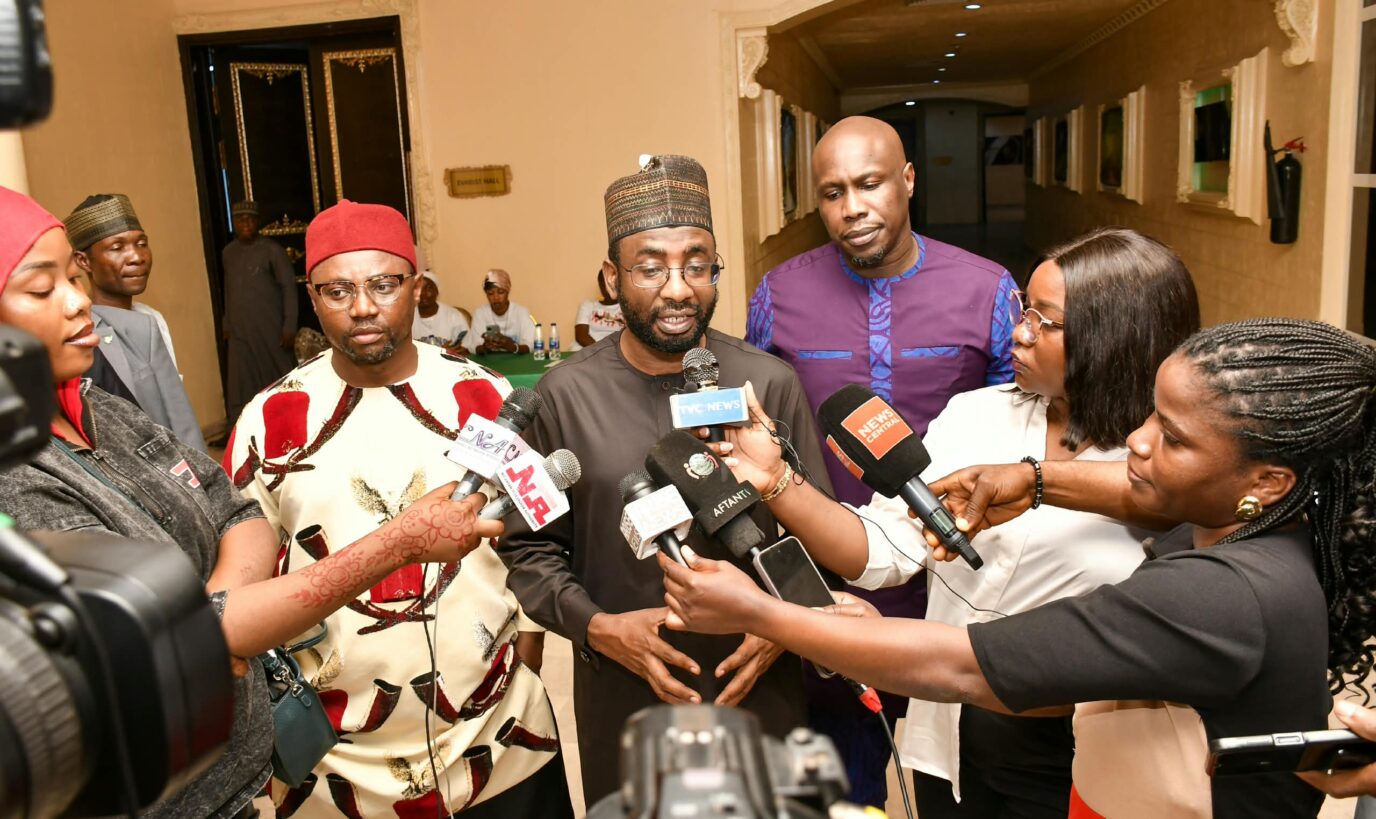
President Bola Tinubu is redirecting Nigeria’s economy from consumption-driven spending to production, innovation and investment, the Director-General of the National Information Technology Development Agency, Kashifu Abdullahi, has said.
Abdullahi said the administration’s economic reforms were designed to strengthen the country’s productive capacity, attract long-term investments and create opportunities for Nigerians.
He stated this on Thursday at a workshop organised by the Tinubu Movement for Sustainable Governance Foundation in Abuja.
The NITDA boss, who is also the national coordinator of the movement, urged Nigerians to support the administration’s reform agenda, saying the country could no longer depend largely on policies that subsidise consumption at the expense of production.
According to him, successive governments committed substantial resources to subsidising consumption without adequately investing in the productive sectors of the economy.
“We spend most of our resources trying to subsidise consumption. When President Bola Ahmed Tinubu came on board, he looked at it. Is it consumption we should subsidise, or production, innovation and investment? That is what the reforms are all about,” he said.
Abdullahi explained that the workshop was organised to enlighten Nigerians about the administration’s Renewed Hope Agenda and encourage citizens to contribute ideas towards national development.
He listed the integration of digital skills into formal education, the introduction of Technical and Vocational Education and Training, and the student loan scheme as some of the initiatives aimed at expanding opportunities for Nigerians.
The NITDA DG also highlighted the agency’s Digital Literacy for All initiative, the deployment of more than 19,000 National Youth Service Corps digital literacy champions to markets and motor parks, and the Three Million Technical Talent programme.
He said the initiatives were designed to equip young Nigerians with relevant skills, improve their employability and position them to participate in the global digital economy.
On the need for policy consistency, Abdullahi argued that sustainable economic development required patience, the right policies and an environment capable of attracting long-term investors.
“No country in the world developed in less than 30 years. The fastest developed country is South Korea. It took 30 years.
“To develop, you need the right policies first. That is the foundation Mr President is laying. Then you build on it to get investors,” he said.
He described reforms as a continuous process, stressing that Nigerians needed to understand the objectives of government policies and the benefits they were expected to deliver.
“Reform is a journey; it is not a one-off event. The essence of this movement is to enlighten Nigerians on these reforms so they can understand what is in it for them. You are the ultimate beneficiary,” Abdullahi added.
Also speaking, a member of the TMS Board of Trustees, Olujonwo Obasanjo, said the movement was established to bridge the information gap between the government and citizens.
Obasanjo identified the establishment of regional development commissions and the administration’s commitment to local government autonomy as measures intended to promote inclusive development and bring governance closer to the people.
He, however, said Nigeria’s development challenge was not necessarily a lack of ideas but the failure to sustain policies across successive administrations.
“Nigeria’s development challenge has never been lack of ideas, but policy discontinuity. There is the need for sustained, uninterrupted reforms to consolidate gains, drive economic growth and ensure that ongoing investments translate into lasting prosperity,” he said.
The Director-General of TMS, Marcel Ngogbehei, acknowledged that the economic reforms had imposed hardship on Nigerians.
He, however, maintained that policy continuity was necessary to attract long-term investments and ensure that the benefits of the reforms eventually reached households.
