

By Abubakar Yakubu in Abuja
As a result of the economic hardship affecting people in the country, a call has been made to the federal, states and local governments to adopt Waqf (Islamic endowment) in combating the socio-economic challenges faced.
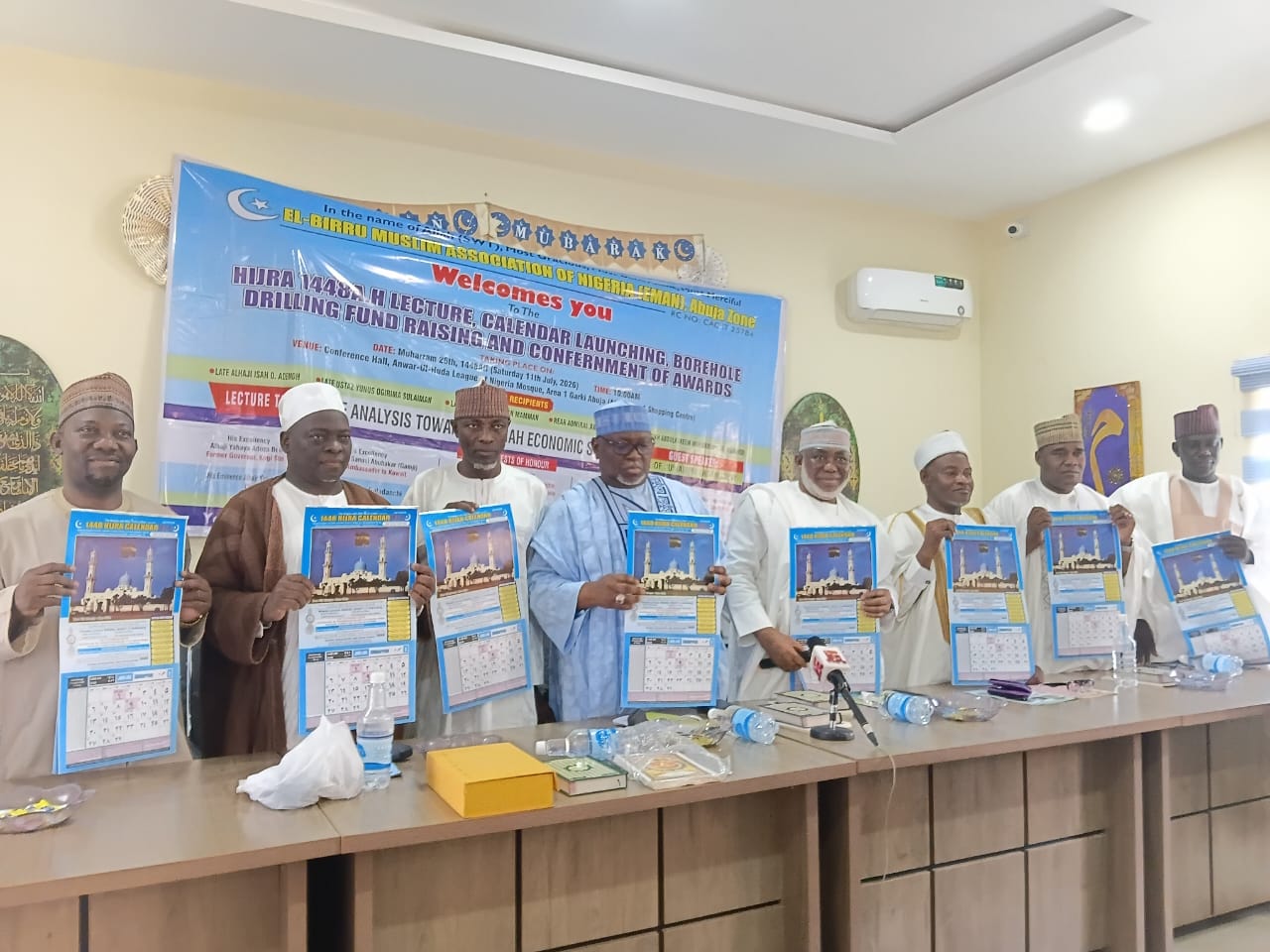
Prof. Juwairiya Badamasuiy, who made the call during the 1448 A.H. lecture, fund raising for boreholes drilling, calendar launch and presentation of honourary awards event organized by the El-Birru Muslim Association of Nigeria (EMAN) in Abuja on Saturday, said Waqf can complement government’s efforts in promoting development and social welfare.
She said many Muslim societies including those in Nigeria face poverty, unemployment, housing shortages, educational deficits and healthcare challenges, adding that Waqf can contribute significantly in addressing such problems through poverty reduction incomes generated from Waqf assets.
Such assistance according to her, can fund food assistance; microfinance programmes; skills acquisition initiatives; educational development, whereby Waqf can support schools, universities, scholarships and research grants; healthcare delivery, where Waqf resources can establish hospitals/clinics, diagnostic centres, mobile health services, and economic empowerment, whereby Waqf investments can create through employment opportunities, small businesses support schemes and voluntary training programmes.
The don noted that the Waqf practice closely aligns with modern Sustainable Development Goals (SDGs), as it contributes to no poverty through its social welfare and income support programmes.
“Other alignments are the funding of food programmes and agricultural projects to combat zero hunger; provisions of hospital and medical services to ensure good health and well-being; ensuring quality education through the provision of educational institutions and scholarships; providing descent work and economic growth through productive investments and job creations; and the by reducing inequalities by redistributing resources to disadvantaged groups.
She explained that the practice of Waqf dates back to the time of the Holy Prophet Muhammed (S.A.W), when Muslims’ dedicate permanently, lawful and valuable property or asset for the sake of Allah.
“The corpus of the asset remains intact, while its benefits or proceeds are utilized to charitable or other Shariah compliment purposes such as religion or public wealth,” she stated.
She said although the practice has some challenges, it can be strengthened by engaging qualified professionals to manage Waqf institutions; employing modern technology for transparency and efficiency; religious leaders and educational institutions should promote the practice of Waqf; government should enact effective Waqf laws; and Waqf assets should be invested in halal and sustainable ventures, while there must be collaborations between government, NGOs and private institutions to enhance Waqf performances in Nigeria.
Earlier in his welcome address, EMAN’s Abuja Zone Ameer, Engr. Zuqarmain I. Abdulrahim, urged Muslims to strive to propagate Islam through their attributes and characters.
He said it was the attributes the Holy Prophet Muhammed possessed that made lots of non- Muslims to join Islam, urging that Muslism should contie to read the Holy Qu ‘ran and other Islamic books to practice and relay the teachings to their daily conducts.
Highlights of the event were the conferment of awards to late Alhaji Isa Ovurevu Ademoh, Ustaz Yunus Suleiman Ogirima, Late Architect Abdul Yekeen Mamman, Rear Admiral Abdullahi Ahmed, and Ustaz Abdulkarim Muhammad. The association also launched its Hijrah Calendar and did a fundraising for the drilling of boreholes.
