

By Jibrin Abubakar, PhD
In his 2012 book, titled, Onward, the CEO of Starbucks, Howard Schultz, penned: “Any business today that embraces the status quo as an operating principle is going to be on a death march.”
Schultz’s metaphor finds validation in Nigeria’s petroleum sector, where Dangote Petroleum Refinery now encounters not just market forces but what industry insiders describe as ‘an entire ecosystem of entrenched interests’ protecting the troubled status quo.
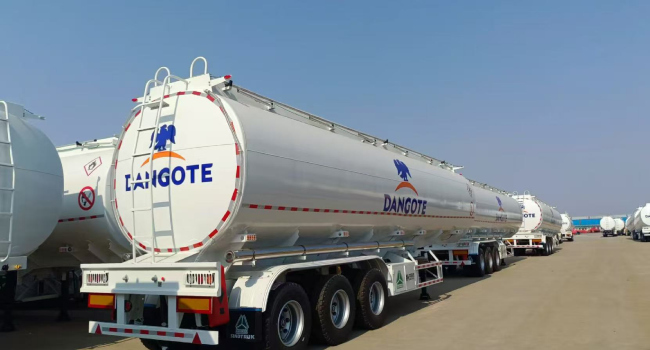
To combat this systemic challenge, Dangote Refinery is implementing a strategic solution: the phase rollout of 4,000 Compressed Natural Gas (CNG)-powered trucks, complemented by a network of specialized refueling stations. This innovative logistics framework is designed to circumvent Nigeria’s chaotic fuel distribution network, while promoting cleaner energy alternatives.
The trucks, according to the company, will supply petroleum products directly to retailers, industrial users, and critical infrastructure operators, including telecoms providers and airports.
By cutting out middlemen and leveraging cheaper CNG, the scheme aims to reduce transport costs, which is a long-overdue remedy for a country where fuel scarcity and price volatility have stifled growth.
Petroleum economists have always attributed volatile global oil prices to geopolitical tensions and supply disruptions, fluctuations that traditionally trigger domestic fuel hikes in import-dependent Nigeria.
Analysts anticipate that Dangote’s integrated logistics network could now cushion these shocks, stabilizing pump prices despite international market turbulence.
As with any transformative move, the 650,000bpd refinery seems to have stirred up a hornet’s nest and spurred commentariats.
The multibillion-dollar petroleum complex anticipates at least 15,000 new jobs, coinciding with the logistics plan, estimated at N720 billion- an exercise projected to save Nigeria over N1.7 trillion yearly.
Market watchers note that Dangote’s CNG fleet represents a triple play for Nigeria’s economy: creating mass employment, stabilizing fuel supplies, and undercutting smuggling networks. It would also ensure more stable fuel supplies while maintaining competitive pricing for consumers.
A statement from the company’s spokesman, Anthony Chiejina, had said: “To ensure smooth take-off of this scheme, Dangote Refinery has invested in the procurement of 4,000 brand-new Compressed Natural Gas (CNG)-powered tankers. This phase of the programme will continue over an extended timeframe. The refinery is also investing in Compressed Natural Gas (CNG) stations, commonly referred to as daughter booster stations, supported by a fleet of over 100 CNG tankers across the country to ensure seamless product distribution.
“This strategic programme is part of our broader commitment to eliminating logistics costs, enhancing energy efficiency, promoting sustainability and supporting Nigeria’s economic development. It affirms our dedication to improving the availability and affordability of fuel, in support of broader efforts to strengthen the economy and improve the well-being of all Nigerians.”
The Presidency is not standing aloof.
In its reaction, Presidential Compressed Natural Gas Initiative (PCNGI) welcomed the Refinery’s fuel distribution plan, saying the decision is not just significant in scale, it is strategic.
PCNGI’s Commercial Coordinator, Tosin Coker, said the effort sends a powerful signal to the market that CNG is no longer a future aspiration but a present-day solution to energy cost, emissions, and supply chain risks.
As part of Nigeria’s energy transition strategy, the Federal Government introduced the Presidential CNG Initiative in 2023 to promote widespread adoption of Compressed Natural Gas. Officials project the conversion could deliver significant savings for consumers, with CNG prices potentially lower than conventional petrol or diesel.
Echoing the same thought, Independent Petroleum Marketers Association of Nigeria (IPMAN) described the initiative as a bold move that will be beneficial to the economy. IPMAN also noted that the initiative will help address the long-standing challenge of relying on expensive transportation from coastal depots.
According to The Guardian, IPMAN’s National Publicity Secretary, Chinedu Ukadike, stated that the new model would significantly reduce logistical burdens for independent marketers by delivering more affordable fuel directly to filling stations.
“Our pipelines have been non-functional for years, yet nothing has been done to revive the infrastructure linking the country’s 21 depots. We’ve had to rely on expensive transport from coastal depots. Dangote’s intervention lifts a huge burden off the shoulders of independent marketers,” Mr. Ukadike was quoted as saying.
“Under this initiative, all petrol stations purchasing PMS and diesel from the Dangote Petroleum Refinery will benefit from this enhanced logistics support. Key sectors such as manufacturing, telecommunications, and others will also gain from this transformative initiative, as reduced fuel costs will contribute to lower production costs, reduced inflation, and foster economic growth. Players in these key sectors and others can purchase directly from the Dangote Petroleum Refinery.
“In addition, the refinery will offer a credit facility to those purchasing a minimum of 500,000 litres—allowing them to obtain an additional 500,000 litres on credit for two weeks, under bank guarantee.
Aside from fuel easily getting to people’s doorposts across the country, the IPMAN spokesperson said the company’s new plan will relieve marketers of unnecessary costs.
“But if you look at Dangote’s statement you will see that a heavy load has been lifted out of the independent marketers,” he said.
Aligning his thought with IPMAN’s, the Chief Executive of Financial Derivatives Company, Bismarck Rewane, said the company’s free distribution initiative would reduce production costs, ease inflationary pressures, and stimulate economic growth. He dismissed concerns about the refinery becoming a monopoly and argued that inefficiencies in the sector had been systemic and long-standing, adding that the scheme would help curb the parasitic role traditionally played by middlemen.
“What Dangote is doing achieves two key objectives: delivering products across the entire country at a uniform price by eliminating bridging costs and significantly reducing logistics expenses using Compressed Natural Gas (CNG)-powered trucks to reach every corner of the nation. In economic terms, middlemen (who typically do not invest) are often viewed as parasitic, extracting margins simply for distributing goods. Dangote is bypassing this layer by directly handling distribution and, notably, providing credit facilities to the retail end of the business,” Mr. Rewane said.
In contrast, the Channels TV reports that the company’s fuel distribution plan was greeted with complaints by oil marketers under the auspices of the Petroleum Products Retail Outlets Owners Association of Nigeria (PETROAN). The group said the initiative would deprive depot owners, truck operators, and retail outlets who have special deals for the direct delivery of petrol and diesel to large corporations and multinationals.
There are also concerns over job losses. However, that claim overlooks a key point: the new trucks will be operated by Nigerian drivers and logistics personnel.
Co-founder of Dairy Hills, Kelvin Emmanuel, noted that Dangote’s strategy would significantly reduce distribution costs, a critical step toward passing the gains of refining on to Nigerian consumers.
Dangote’s initiative is not altogether new in the global oil space. While Dangote’s approach mirrors strategies employed by oil majors like Saudi Aramco, for instance; its implementation reflects unique adaptations to Nigeria’s challenging operating environment.
Cheaper logistics, experts say, would translate to lower pump prices, lower inflation, and more profitability for small enterprises. With Nigeria’s supply chain costs consuming nearly half of product prices in certain industries, any cost-cutting measure would be a welcome idea for the economy.
There are indications that early deployment of the new trucks will concentrate on major commercial cities, and gradually into the hinterlands and to every corner of the country.
Similarly, the CNG refueling stations are expected to be rolled out in stages, starting alongside the deployment of the tankers.
The company has also sought to allay concerns about monopoly of the downstream logistics sector.
The company’s management also said it plans to list the petroleum complex on the stock exchange, a move widely applauded by stakeholders.
At an event in Abuja recently, President of the Dangote Industries Limited(DIL), Aliko Dangote, said: “The reality is that for too many people who have both the means and the opportunity to contribute meaningfully to our nation’s growth, choose instead to criticize from the sidelines while investing their wealth abroad, adding little to Nigeria’s real economy. We have chosen to bet on Nigeria and will continue to do so.”
Beyond NNPC, Nigeria’s refining landscape now includes nine modular plants, with regulatory frameworks actively welcoming new investors to expand capacity.
Analysts suggest that by vertically integrating its supply chain, Dangote could directly translate operational efficiencies into consumer cost savings.
According to the company: “This initiative is in line with the Renewed Hope Agenda of His Excellency, President Bola Ahmed Tinubu, reflecting our shared commitment to economic progress, stability, and inclusive development. We sincerely thank the Federal Government for its continued support, especially through the Naira-for-Crude scheme, which has helped stabilize fuel supply amid global price volatility. It marks a major revolution in the midstream and downstream sectors and stands as a key example of President Bola Tinubu’s bold and reformative economic policies.”
With its game-changing fleet of CNG trucks, Dangote Refinery isn’t just transporting fuel, it’s driving Nigeria’s energy future.
Dangote Petroleum Refinery’s bold move has cracked the old system, proving that cleaner, cheaper and more efficient energy logistics are possible.
Dr. Abubakar writes from Adamawa Plaza, Central Business District, Abuja.
