

By Bizuum Yadok
Let us assume that Nigeria does not survive as a nation and, somehow, its northern part collects large portions of its surrounding countries around West Africa and becomes known as the United States of West Africa (UNWA). Let’s also assume that it miraculously prospers rapidly.
Now let us stop assuming because that is the alternate reality that Nathaniel Bivan presents in his debut novel, Boys, Girls, and Beasts. This goes without saying that it is a speculative fiction, but it is set in the United Nations of West Africa beginning from 2068. The advancement of this new nation is suddenly thwarted by the intrusion of destructive militants known as the Warriors, who go about invading the states of UNWA, one after another, as they aim for the capital state, Madamani.
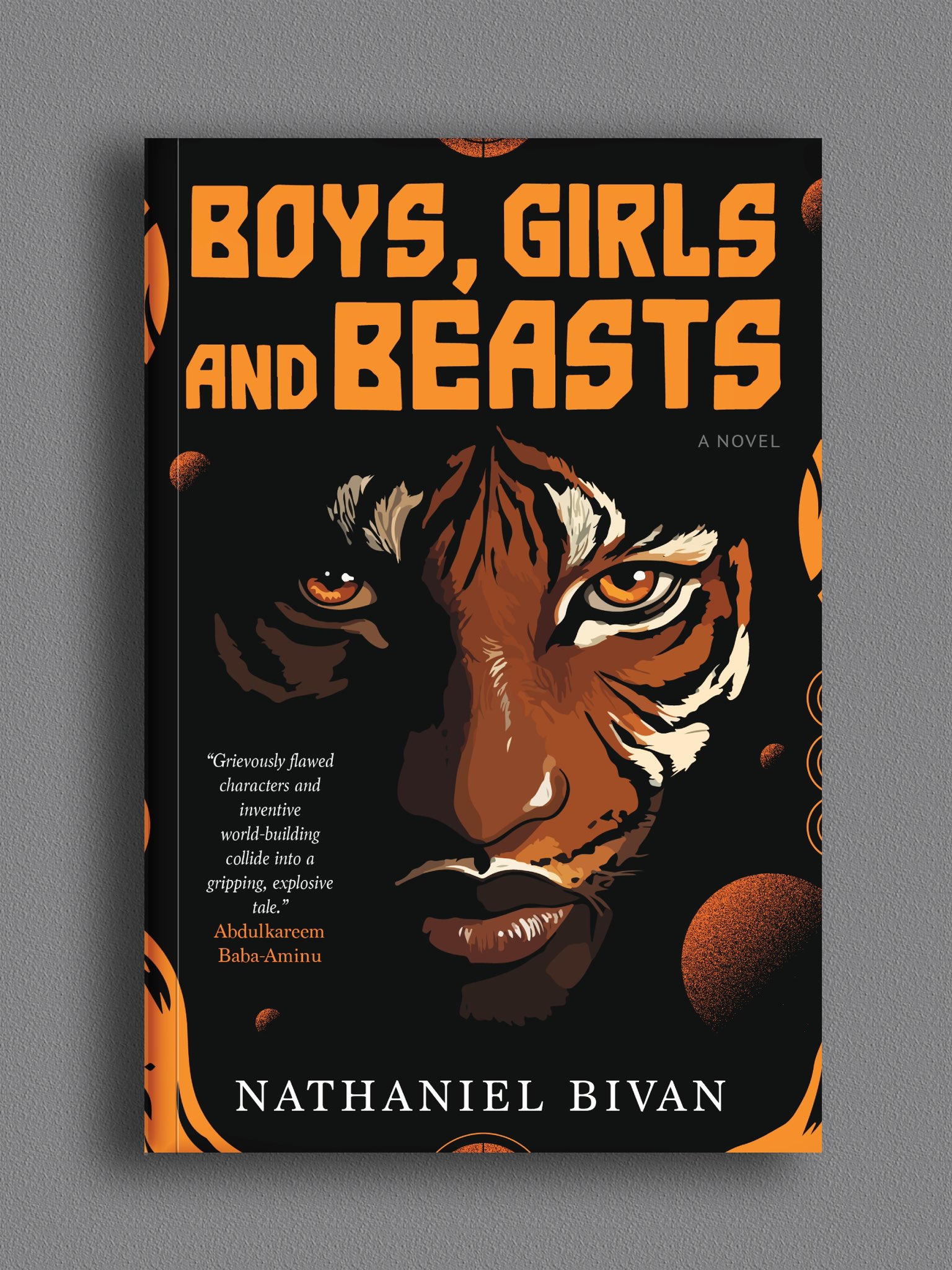
In one of their early onslaughts, we meet our protagonist, Jaka, whose family is on the run and he becomes the only survivor. Usually, the captives of every attack are categorized as recruits, vessels, and bombs. Vessels and bombs are mostly girls. It becomes more interesting here because, even as a teenager, Jaka is conscripted to join the Warriors and upon initiation he operates two forms – a human and a tiger – and his mind vacillates between two spirits. Other recruits, with the enabling power of the Tahus seed and a concoction of herbs, become Jaguars or some other wild animals at the event of any combat. The Tahus seed is a product of a distant planet from where the Warriors originate.
These seemingly invincible and increasing band of fighters led by Sky Blue and Flint Grey meet their waterloo at the end of Part One of the novel, yet somehow, Jaka survives. Will he proceed with the invasion of other states or just turn around and surrender? Well, that is left for the reader to know but there’s actually a lot more to the story.
Boys, Girls, and Beasts, blends several subgenres of speculative fiction in one narrative fabric. Thus, we see science fiction, esoteric space travel, fantasy, alternate history, dystopian fiction, and horror converging to deliver the story. Equally interesting is the author’s power to create a language called the Wa Creole which the locals of UNWA speak; his stringing of sentences in that language, even though with the advantage of context clues, makes the language familiar and strange at the same time.
Following his debut novel, Bivan’s readers are bound to expect his next offering, perhaps a sequel to Boys, Girls, and Beasts, because he is skilled at creating empathetic characters – Jaka and Tabitha for example – who may have committed some atrocities, in the case of Jaka, but are loved by the readers nonetheless. The naming of characters like Sky Blue, Flint Grey, Baritone, and Gunner, is quite striking as their names don’t tell who they are, where they are from, or what they do, rather their actions define them.
The icing on the cake for me is the climax of the novel, which even feels like a movie, but I can’t afford to spoil if for you. Can I?
I should also mention the exquisite cover design of the book, reader-friendly fonts, enticing texture of paper, colourful maps, and other features that add to the book’s physical integrity unconsciously propel the reader to the end. However, only the meticulous reader will be able to detect obstinate typos or descriptive inconsistencies in the text. In any case, regardless of whatever verdict that will be passed on the book, the kernel must be that it is an excellent narrative.
Nathaniel Bivan has worked extensively as solutions and conflict journalist for about two decades. Therefore, it is not difficult to find the marks of his journalistic experience in his writing. For some of us, Boys, Girls, and Beasts might well be an allegorical tale but that is up for debate.

Bizuum Yadok is a teacher, writer, and literary administrator.
bizuumyadok@gmail.com
