

OPINION
NECO @ 25: Wushishi’s Reforms and the Rise of Credible Assessment
By Yakubu Mustapha Bina
The National Examinations Council, NECO, turned 25 this year. For an institution born out of necessity in April 1999, its Silver Jubilee is more than a birthday. It is a moment to assess how far Nigeria has come in democratizing credible assessment, and where leadership has made the difference.
NECO was established during the administration of former Head of State, General Abdulsalami Alhaji Abubakar (retired), to conduct the Senior School Certificate Examination and other national exams. The goal was straightforward: reduce the overwhelming burden on the West African Examinations Council and give Nigerian students a homegrown alternative for certification.
Twenty-five years later, that alternative has become a pillar. More than 35 million candidates have sat for NECO examinations since inception. From the National Common Entrance Examination for primary school leavers, to the Basic Education Certificate Examination at JSS3, to the SSCE for both internal and external candidates, and the National Gifted Examination, NECO now anchors key transition points in Nigeria’s education system.
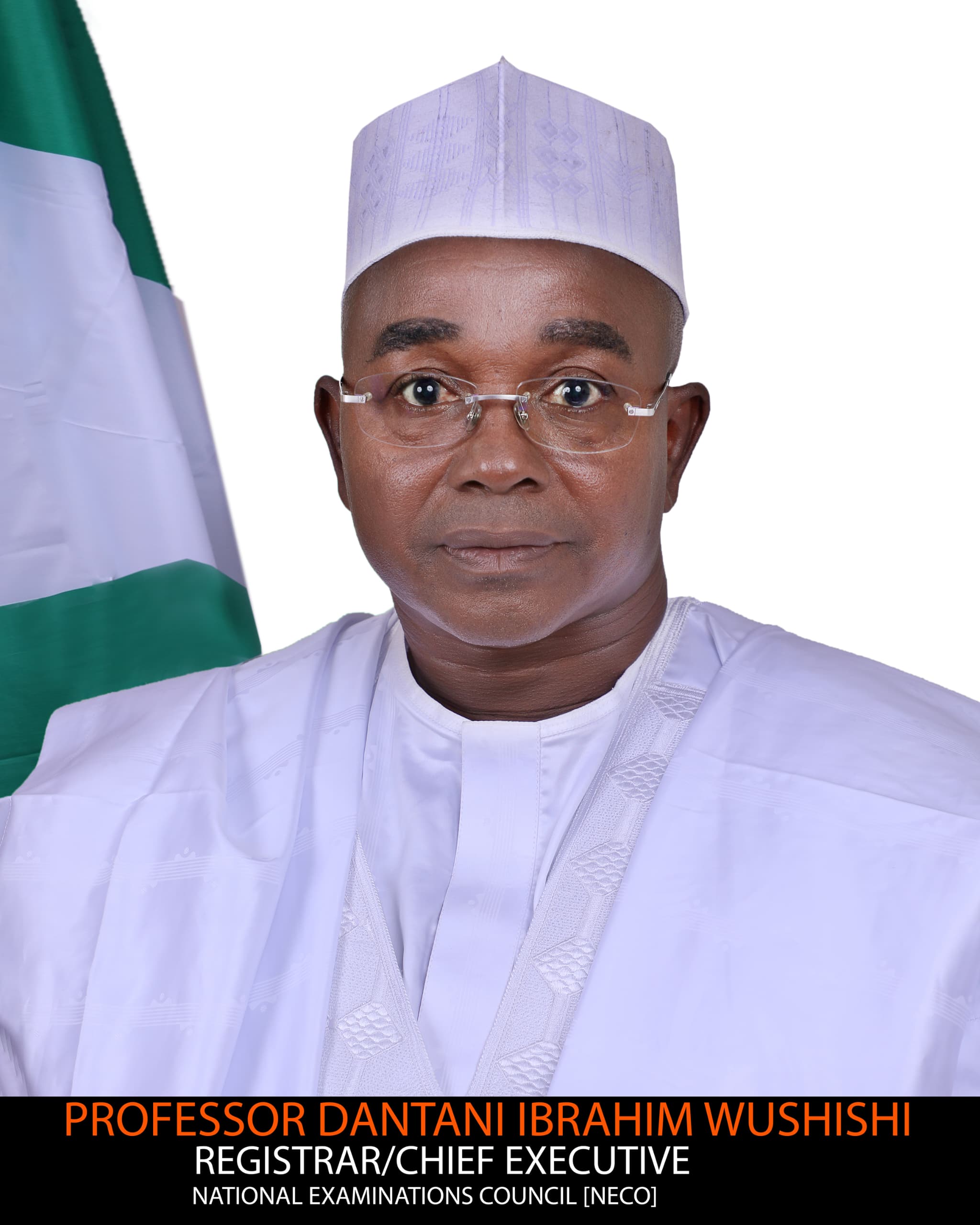
But longevity alone does not equal excellence. The real story of NECO at 25 is how reform, technology, and leadership have reshaped public confidence in an institution that once battled skepticism. Nowhere is that shift clearer than under its current Registrar and Chief Executive, Professor Dantani Ibrahim Wushishi.
Wushishi Takes Charge, 2021
Professor Wushishi assumed office on 12th July, 2021 as the 9th Registrar of NECO. He is also the first indigene of Niger State to lead the Council. Those who work with him describe a style that is calm but firm: humble, inclusive, and big on delegation, monitoring, and accountability.
His tenure has coincided with a deliberate push to modernize NECO’s operations and image. The Council’s mission is to deliver examinations whose results are trusted worldwide. Its vision, to become a leading player in the global assessment industry, no longer sounds aspirational. It looks like a work plan.
CBT and the Digital Shift
The Federal Government’s directive to migrate public examinations to Computer-Based Testing is a defining reform of this era. CBT promises transparency, real-time monitoring, stronger security, and a decisive blow against malpractice.
Under Wushishi, NECO has embraced that transition. The Council rolled out improved online registration platforms and internet-based result processing. It is phasing in CBT in line with international best practices, while upgrading its Optical Mark Recognition scanners and deploying new computer systems across state offices. E-library facilities have been expanded. Operational vehicles have been acquired to ease logistics.
The impact is practical: examinations are conducted more efficiently, scripts are processed faster, and results are released within reasonable timeframes. For candidates and parents who once endured long, anxious waits, timely release of SSCE, BECE, and NCEE results has rebuilt trust.
Technology has also helped the fight against malpractice. With tighter digital controls, biometric verification, and better monitoring, NECO has recorded measurable reductions in infractions. Public confidence, once fragile, is firmer.
People and Welfare Drive Reform
Reform is not only about machines. Professor Wushishi has placed emphasis on staff welfare and professional growth. Regular promotion exercises have been conducted. Continuous development programmes are ongoing. Improved working conditions have lifted morale and productivity.
Critically, government intervention funds secured under his leadership have ensured prompt payment of examiners and ad hoc personnel. Anyone familiar with exam administration in Nigeria knows what delayed payments do to motivation and integrity. Paying people on time is an anti-corruption strategy in itself.
NECO Goes Global
Perhaps the most striking marker of NECO’s new credibility is its international footprint. NECO examinations are now conducted for Nigerian students in the United Kingdom, Saudi Arabia, Benin Republic, Togo, Côte d’Ivoire, Equatorial Guinea, Niger Republic, and Gabon.
That expansion matters. It means Nigerian certificates are being accepted and supervised abroad. It gives diaspora students access without the logistical nightmare of returning home to write exams. And it signals that NECO’s quality assurance mechanisms meet standards beyond our borders. The Council says it is exploring more countries, in line with its ambition to be globally recognized.
Minister Alausa’s Endorsement
At NECO’s 25th Anniversary celebration in Abuja, the Honourable Minister of Education, Dr. Tunji Alausa, called the Council’s journey “pivotal to Nigeria’s educational development.” He pointed to stronger accountability, expanded access, and restored public confidence through consistent reforms.
That endorsement reflects a broader reality: assessment bodies are national infrastructure. When they work, universities admit with confidence, employers hire with certainty, and students plan their futures without fear that a certificate will be questioned.
Building on Past Registrars
NECO’s progress is not the work of one administration. The foundation was laid by pioneers who navigated the Council’s difficult early years.
Professor Dibu Ojerinde served as pioneer Registrar from 1999 to 2007, building the institutional framework. He was succeeded by a line of distinguished administrators: Professor Promise Okpalla, Professor Monday Tommy Joshua, Professor Abdul Rashid Garba, Professor Charles Uwakwe, Mr. Abubakar Gana in acting capacity, Professor Godswill Obioma, and Mr. Ebikibina John Okporodi who also served in acting capacity before Professor Wushishi’s appointment.
Each faced unique challenges: funding gaps, infrastructure deficits, and the uphill task of earning public trust in a new exam body. Their efforts created the platform on which today’s reforms stand.
From Doubt to Credibility
NECO’s first decade was not easy. Limited public confidence, operational constraints, and concerns about credibility dogged the Council. Some institutions were reluctant to accept its certificates. Malpractice was a national headache that no exam body could escape.
What changed the story was sustained reform. Stronger quality assurance. Better security protocols. Transparent processes. And, crucially, consistency. Under Wushishi, those gains have been consolidated. The Council’s growing acceptance among universities, employers, and professional bodies at home and abroad is evidence that the turnaround is real.
The Professor Wushishi Profile
Professor Dantani Ibrahim Wushishi, born 5 April 1965 in Wushishi LGA of Niger State, came to NECO with a reputation earned in academia and educational administration. Diligence, integrity, and discipline are words that come up often from those who have worked with him.
As Registrar, he has pushed technology-driven reforms without losing sight of fairness and access. He has kept examination processes secure yet open to all candidates. His leadership traits: humility, accountability, calmness, empathy, fairness, inclusiveness, have fostered teamwork inside NECO and respect outside it.
He has received several honours for excellence in educational administration and for promoting technology-driven reforms. Communities have conferred traditional titles on him in recognition of service. For Wushishi, the saying holds true: “To avoid criticism, do nothing, say nothing, and be nothing.” He has chosen to do something.
Stakeholders Share the Credit
No Council runs on one man. The Governing Board, under Professor Modupe Adelabu, has provided strategic direction. Management, departmental heads, staff, examiners, and ad hoc personnel have carried the daily weight of delivering credible exams to millions.
The Federal Government and Federal Ministry of Education have backed reforms with policy and funding. State governments, schools, parents, candidates, and the public have kept faith with the process. Development partners have supported capacity and infrastructure. NECO’s 25-year milestone belongs to all of them.
What Next for NECO
The next phase for NECO is clear. First, deepen digital technology. The CBT migration must expand until it becomes the default, not the exception. Second, keep tightening examination security. Tech helps, but vigilance and training are constant. Third, pursue wider international recognition so that a NECO certificate travels as easily as any other.
Investment in staff development must continue. Quality assurance can’t be a one-off project; it has to be culture. If NECO sustains its current trajectory of credible exams, prompt results, and improved service delivery, it will consolidate its place as a leading assessment body in Africa.
Beyond 25 Years
NECO at 25 is not just a celebration of survival. It is a celebration of resilience, innovation, and institutional maturity. From 1999 to 2025, the Council has grown from a stopgap to a standard-setter. It has given 35 million Nigerians a pathway to the next level of their education and careers.
The last four years under Professor Dantani Ibrahim Wushishi show what purposeful leadership can do: modernize systems, motivate people, and restore trust. There is still work to do. But there is now a template for how to do it.
If Nigeria is serious about educational development, it must keep investing in the integrity of assessment. Because when examinations are credible, the entire system works better. And at 25, NECO is proving that point, one candidate, one reform, one result at a time.
Yakubu Mustapha Bina is a journalist and public affairs analyst based in Minna, Niger State. He can be reached at yamustibina@gmail.com.
